

Gynecology 4
Gynecology 4
0 of 50 questions completed
Questions:
- 1
- 2
- 3
- 4
- 5
- 6
- 7
- 8
- 9
- 10
- 11
- 12
- 13
- 14
- 15
- 16
- 17
- 18
- 19
- 20
- 21
- 22
- 23
- 24
- 25
- 26
- 27
- 28
- 29
- 30
- 31
- 32
- 33
- 34
- 35
- 36
- 37
- 38
- 39
- 40
- 41
- 42
- 43
- 44
- 45
- 46
- 47
- 48
- 49
- 50
Information

You have already completed the Test before. Hence you can not start it again.
Test is loading...
You must sign in or sign up to start the Test.
You have to finish following quiz, to start this Test:
Your results are here!! for" Gynecology 4 "
0 of 50 questions answered correctly
Your time:
Time has elapsed
Your Final Score is : 0
You have attempted : 0
Number of Correct Questions : 0 and scored 0
Number of Incorrect Questions : 0 and Negative marks 0
| Average score |
|
| Your score |
|
-
Not categorized
You have attempted: 0
Number of Correct Questions: 0 and scored 0
Number of Incorrect Questions: 0 and Negative marks 0
-
Gynaecology
You have attempted: 0
Number of Correct Questions: 0 and scored 0
Number of Incorrect Questions: 0 and Negative marks 0
- 1
- 2
- 3
- 4
- 5
- 6
- 7
- 8
- 9
- 10
- 11
- 12
- 13
- 14
- 15
- 16
- 17
- 18
- 19
- 20
- 21
- 22
- 23
- 24
- 25
- 26
- 27
- 28
- 29
- 30
- 31
- 32
- 33
- 34
- 35
- 36
- 37
- 38
- 39
- 40
- 41
- 42
- 43
- 44
- 45
- 46
- 47
- 48
- 49
- 50
- Answered
- Review
-
Question 1 of 50
1. Question
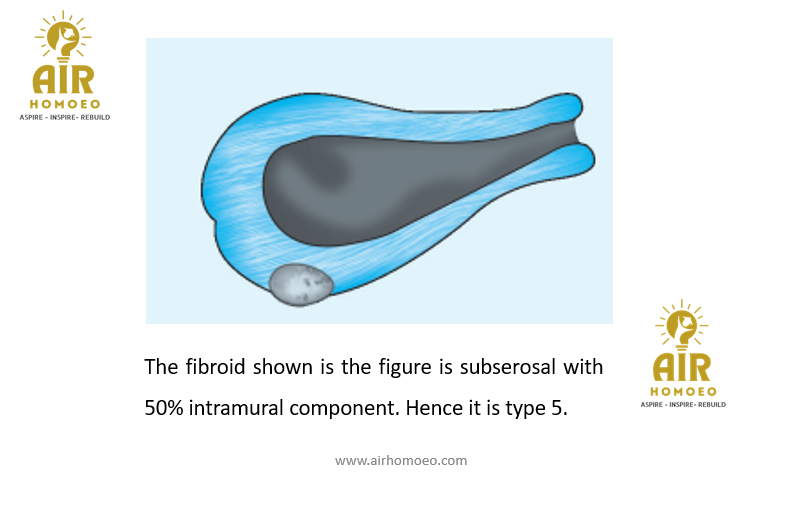
A fibroid is described as subserosal with approximately 50% intramural component. According to the FIGO classification, this fibroid is:
Correct
 Incorrect
Unattempted
-
Question 2 of 50
2. Question
Commonest site for fibroid is –
Correct
The most common site for uterine fibroids (leiomyomas) is the intramural location, where the fibroid is situated within the myometrium. Intramural fibroids account for approximately 70% of all fibroids. They can distort the uterine cavity if large and may cause symptoms like menorrhagia, dysmenorrhea, and infertility. Submucous fibroids are less common but more likely to cause heavy menstrual bleeding, while subserous fibroids project outward from the uterus. Cervical fibroids are rare.
Incorrect
The most common site for uterine fibroids (leiomyomas) is the intramural location, where the fibroid is situated within the myometrium. Intramural fibroids account for approximately 70% of all fibroids. They can distort the uterine cavity if large and may cause symptoms like menorrhagia, dysmenorrhea, and infertility. Submucous fibroids are less common but more likely to cause heavy menstrual bleeding, while subserous fibroids project outward from the uterus. Cervical fibroids are rare.
Unattempted
The most common site for uterine fibroids (leiomyomas) is the intramural location, where the fibroid is situated within the myometrium. Intramural fibroids account for approximately 70% of all fibroids. They can distort the uterine cavity if large and may cause symptoms like menorrhagia, dysmenorrhea, and infertility. Submucous fibroids are less common but more likely to cause heavy menstrual bleeding, while subserous fibroids project outward from the uterus. Cervical fibroids are rare.
-
Question 3 of 50
3. Question
The commonest cause of death in carcinoma cervix is-
Correct
In carcinoma cervix, the most common cause of death is renal failure, usually due to ureteric obstruction from advanced disease. Tumor infiltration or external compression by pelvic lymph nodes can cause bilateral ureteric obstruction, leading to hydronephrosis and chronic renal failure. Septicemia, hemorrhage, and cachexia can occur in late stages, but they are less frequent causes of mortality compared to obstructive uropathy and its sequelae.
Incorrect
In carcinoma cervix, the most common cause of death is renal failure, usually due to ureteric obstruction from advanced disease. Tumor infiltration or external compression by pelvic lymph nodes can cause bilateral ureteric obstruction, leading to hydronephrosis and chronic renal failure. Septicemia, hemorrhage, and cachexia can occur in late stages, but they are less frequent causes of mortality compared to obstructive uropathy and its sequelae.
Unattempted
In carcinoma cervix, the most common cause of death is renal failure, usually due to ureteric obstruction from advanced disease. Tumor infiltration or external compression by pelvic lymph nodes can cause bilateral ureteric obstruction, leading to hydronephrosis and chronic renal failure. Septicemia, hemorrhage, and cachexia can occur in late stages, but they are less frequent causes of mortality compared to obstructive uropathy and its sequelae.
-
Question 4 of 50
4. Question
% of malignancy of ovaries in childhood is
Correct
In childhood, most ovarian tumors are benign, but the proportion of malignancy is relatively higher compared to adults. Approximately 10% of ovarian tumors in children are malignant. The most common malignant ovarian tumors in this age group are germ cell tumors (e.g., dysgerminoma, yolk sac tumor), rather than epithelial tumors which predominate in adults.
Incorrect
In childhood, most ovarian tumors are benign, but the proportion of malignancy is relatively higher compared to adults. Approximately 10% of ovarian tumors in children are malignant. The most common malignant ovarian tumors in this age group are germ cell tumors (e.g., dysgerminoma, yolk sac tumor), rather than epithelial tumors which predominate in adults.
Unattempted
In childhood, most ovarian tumors are benign, but the proportion of malignancy is relatively higher compared to adults. Approximately 10% of ovarian tumors in children are malignant. The most common malignant ovarian tumors in this age group are germ cell tumors (e.g., dysgerminoma, yolk sac tumor), rather than epithelial tumors which predominate in adults.
-
Question 5 of 50
5. Question
Not true about red degeneration of myomas is:
Correct
 Incorrect
Unattempted
-
Question 6 of 50
6. Question
Cystic glandular hyperplasia is associated with
Correct
Cystic glandular hyperplasia refers to endometrial hyperplasia with cystic dilation of glands, usually caused by prolonged unopposed estrogen stimulation. Among the tumors listed, theca cell tumors are estrogen-secreting ovarian stromal tumors. The excess estrogen they produce can lead to cystoglandular hyperplasia and even endometrial carcinoma if prolonged.
Incorrect
Cystic glandular hyperplasia refers to endometrial hyperplasia with cystic dilation of glands, usually caused by prolonged unopposed estrogen stimulation. Among the tumors listed, theca cell tumors are estrogen-secreting ovarian stromal tumors. The excess estrogen they produce can lead to cystoglandular hyperplasia and even endometrial carcinoma if prolonged.
Unattempted
Cystic glandular hyperplasia refers to endometrial hyperplasia with cystic dilation of glands, usually caused by prolonged unopposed estrogen stimulation. Among the tumors listed, theca cell tumors are estrogen-secreting ovarian stromal tumors. The excess estrogen they produce can lead to cystoglandular hyperplasia and even endometrial carcinoma if prolonged.
-
Question 7 of 50
7. Question
Which of the following associated with endometrial cancer
Correct
Endometrial cancer is strongly linked to conditions causing prolonged unopposed estrogen exposure.
Metropathica haemorrhagica → Chronic anovulation (often seen in perimenopausal women) leads to unopposed estrogen stimulation and endometrial hyperplasia, a known precursor of endometrial carcinoma.
Fibroid (leiomyoma) itself is not premalignant, but women with fibroids may have anovulatory cycles or estrogen excess, indirectly increasing risk.
Dysgerminoma is a germ cell tumor, not hormonally active, and generally not associated with endometrial carcinoma.
Incorrect
Endometrial cancer is strongly linked to conditions causing prolonged unopposed estrogen exposure.
Metropathica haemorrhagica → Chronic anovulation (often seen in perimenopausal women) leads to unopposed estrogen stimulation and endometrial hyperplasia, a known precursor of endometrial carcinoma.
Fibroid (leiomyoma) itself is not premalignant, but women with fibroids may have anovulatory cycles or estrogen excess, indirectly increasing risk.
Dysgerminoma is a germ cell tumor, not hormonally active, and generally not associated with endometrial carcinoma.
Unattempted
Endometrial cancer is strongly linked to conditions causing prolonged unopposed estrogen exposure.
Metropathica haemorrhagica → Chronic anovulation (often seen in perimenopausal women) leads to unopposed estrogen stimulation and endometrial hyperplasia, a known precursor of endometrial carcinoma.
Fibroid (leiomyoma) itself is not premalignant, but women with fibroids may have anovulatory cycles or estrogen excess, indirectly increasing risk.
Dysgerminoma is a germ cell tumor, not hormonally active, and generally not associated with endometrial carcinoma.
-
Question 8 of 50
8. Question
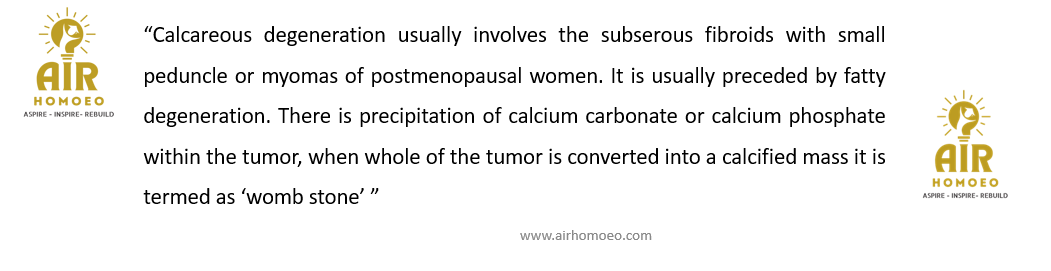
Calcareous degeneration occurs most commonly in which type of fibroids:
Correct
 Incorrect
Unattempted
-
Question 9 of 50
9. Question
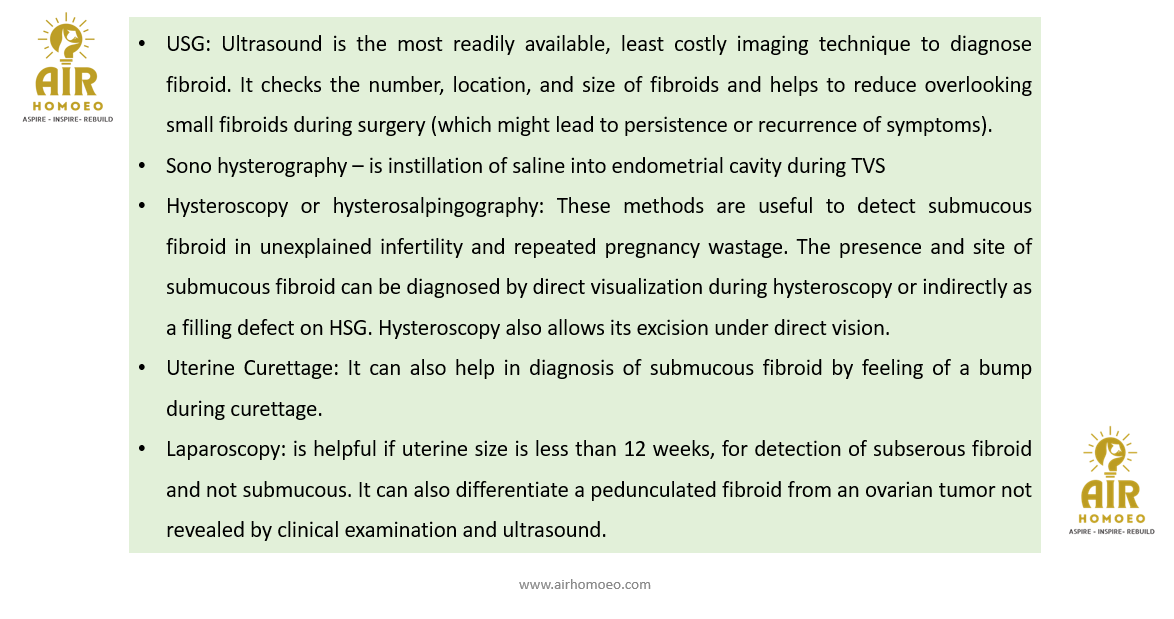
Submucosal fibroid is detected by all except:
Correct
 Incorrect
Unattempted
-
Question 10 of 50
10. Question
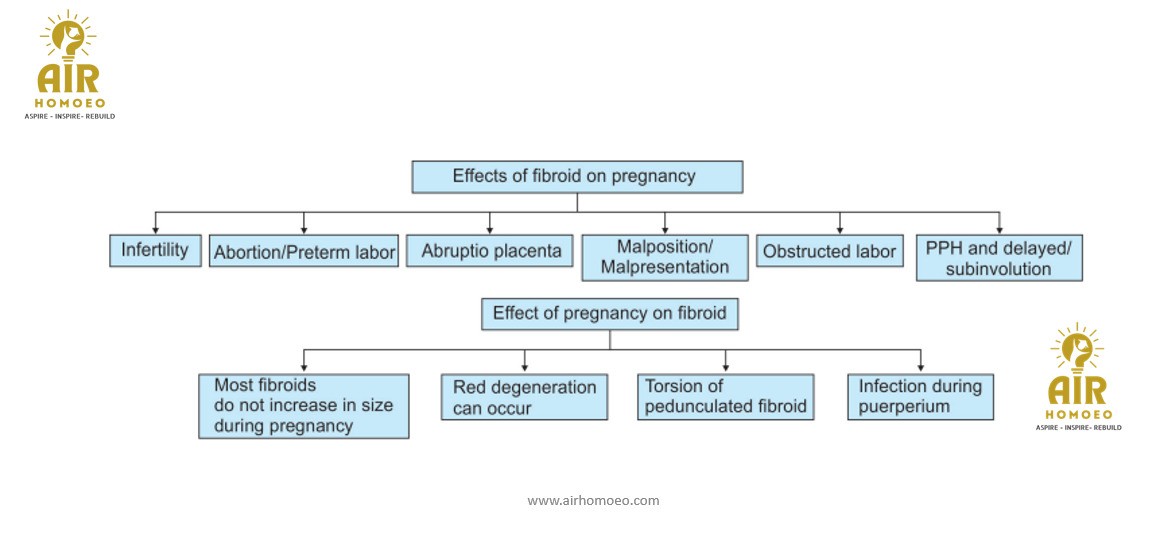
All are complications of fibroid in pregnancy except:
Correct
 Incorrect
Unattempted
-
Question 11 of 50
11. Question
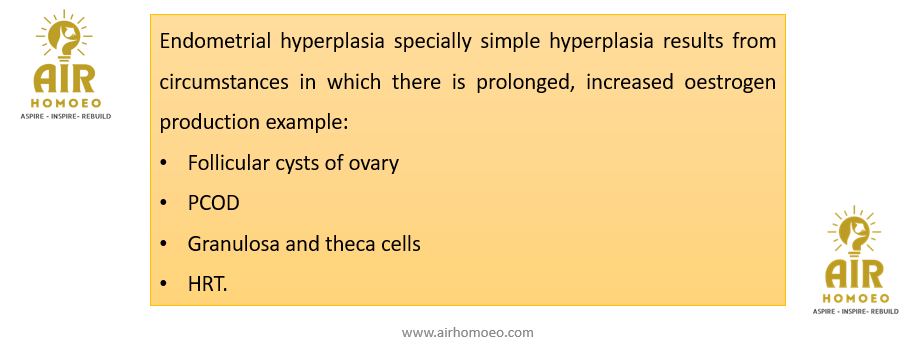
Endometrial hyperplasia is seen in:
Correct
 Incorrect
Unattempted
-
Question 12 of 50
12. Question
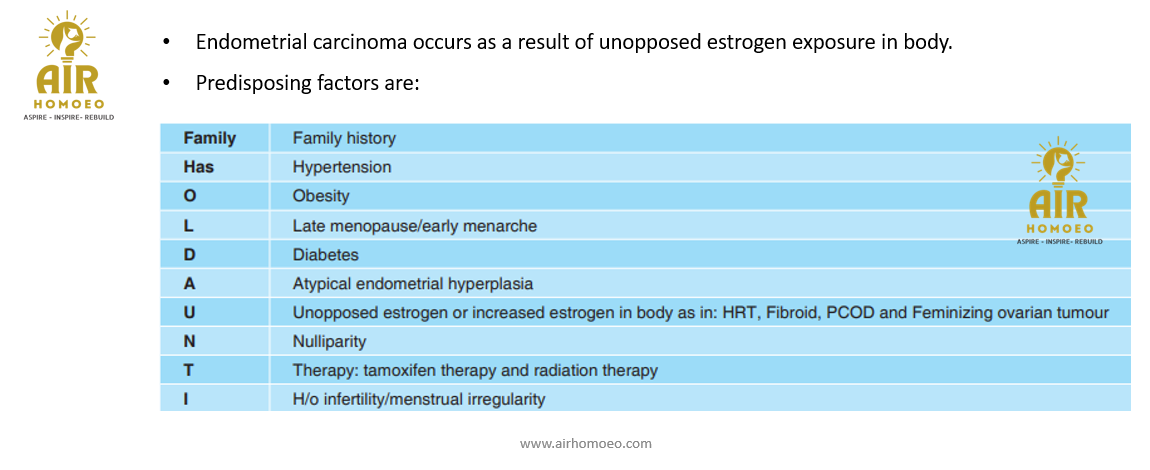
All are the risk factors for endometrial carcinoma except:
A. Multiparity
B. Obesity
C. Early menopause
D. Unopposed estrogen therapy
E. HypertensionCorrect
 Incorrect
Unattempted
-
Question 13 of 50
13. Question
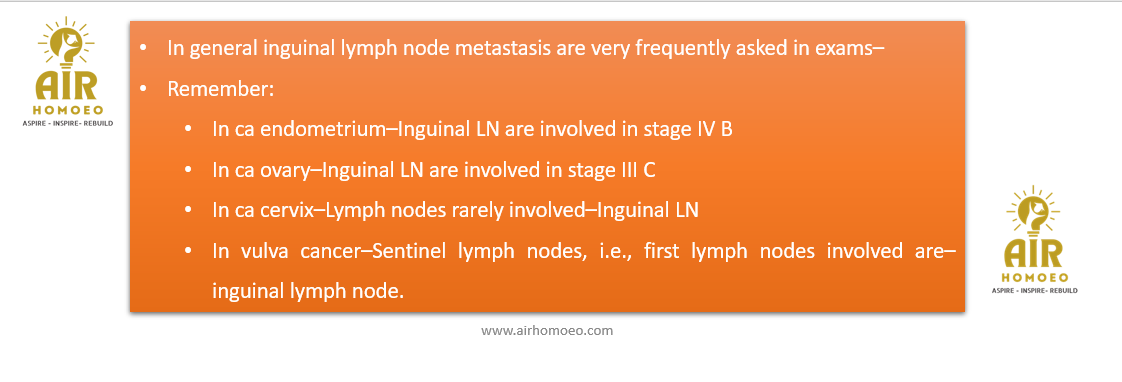
Carcinoma endometrium with positive superficial inguinal lymph node status is classified as stage:
Correct
 Incorrect
Unattempted
-
Question 14 of 50
14. Question
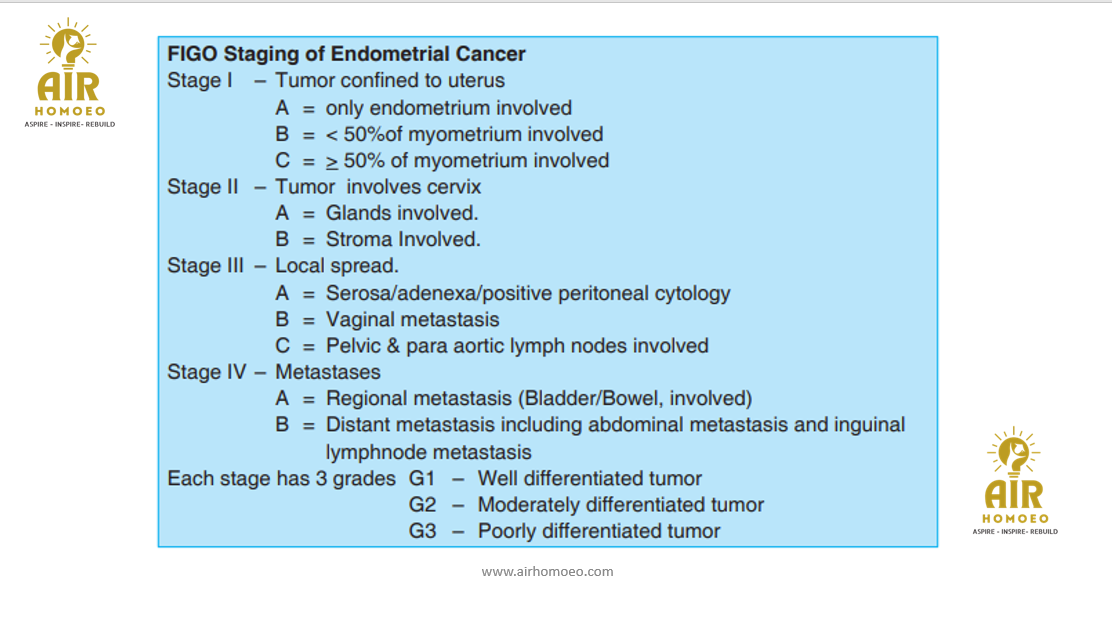
True about endometrial carcinoma in clinical stage III:
A. Vaginal metastasis
B. Para aortic lymph node involvement
C. Pelvic lymph node involvement
D. Peritoneal involvement
E. Inguinal lymph node involvementCorrect
 Incorrect
Unattempted
-
Question 15 of 50
15. Question
True about endometrial carcinoma
Correct
Endometrial carcinoma is most common in postmenopausal women and is strongly associated with obesity, diabetes mellitus, and hypertension (the “corpus cancer triad”). The most common histological type is endometrioid adenocarcinoma, not adenosquamous. It is rarely associated with carcinoma of the cervix, as the two have different etiologies. Peak incidence occurs between 55–65 years, not 20–40 years.
Incorrect
Endometrial carcinoma is most common in postmenopausal women and is strongly associated with obesity, diabetes mellitus, and hypertension (the “corpus cancer triad”). The most common histological type is endometrioid adenocarcinoma, not adenosquamous. It is rarely associated with carcinoma of the cervix, as the two have different etiologies. Peak incidence occurs between 55–65 years, not 20–40 years.
Unattempted
Endometrial carcinoma is most common in postmenopausal women and is strongly associated with obesity, diabetes mellitus, and hypertension (the “corpus cancer triad”). The most common histological type is endometrioid adenocarcinoma, not adenosquamous. It is rarely associated with carcinoma of the cervix, as the two have different etiologies. Peak incidence occurs between 55–65 years, not 20–40 years.
-
Question 16 of 50
16. Question
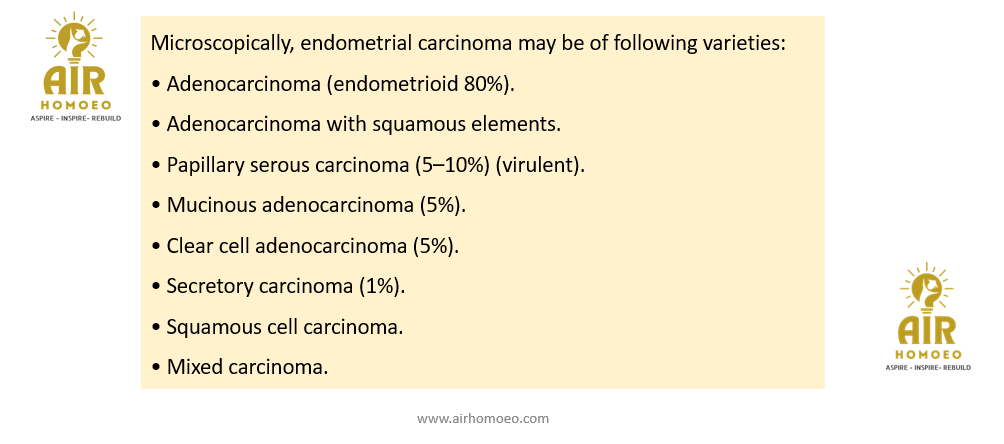
Primary carcinoma body of the uterus may be of following types except:
Correct
 Incorrect
Unattempted
-
Question 17 of 50
17. Question
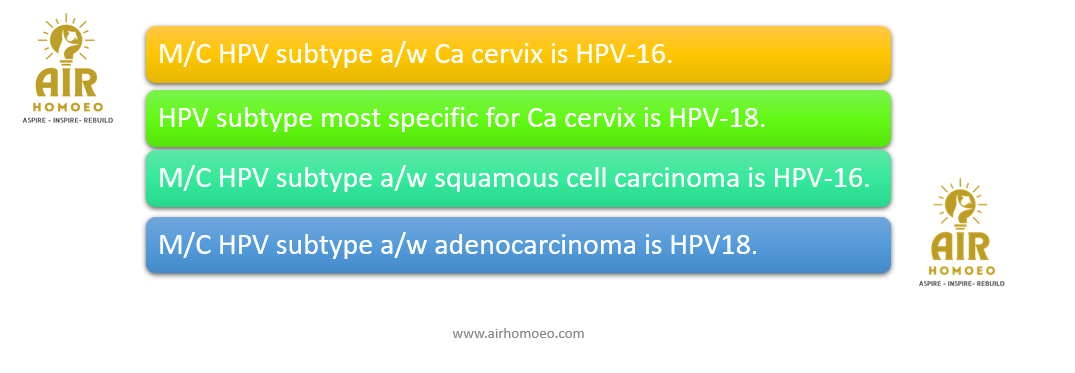
Most common subtype associated with adenocarcinoma is
Correct
 Incorrect
Unattempted
-
Question 18 of 50
18. Question
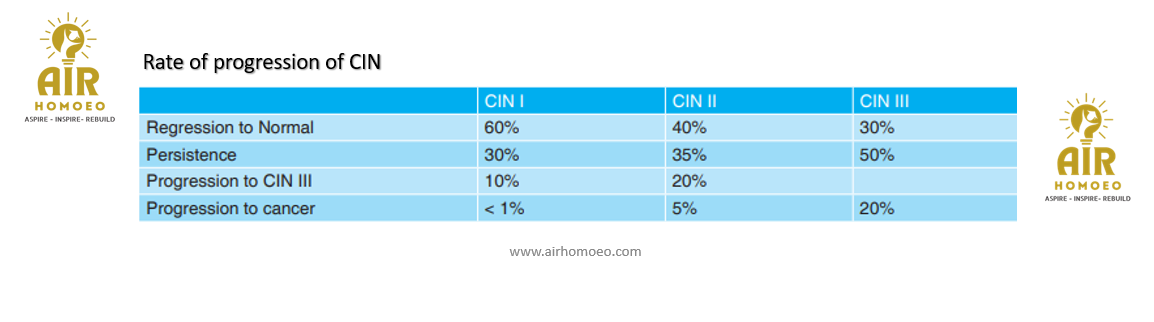
A patient is diagnosed to have CIN II. She approaches you for advice. You can definitely tell her the risk of malignancy as:
Correct
 Incorrect
Unattempted
-
Question 19 of 50
19. Question
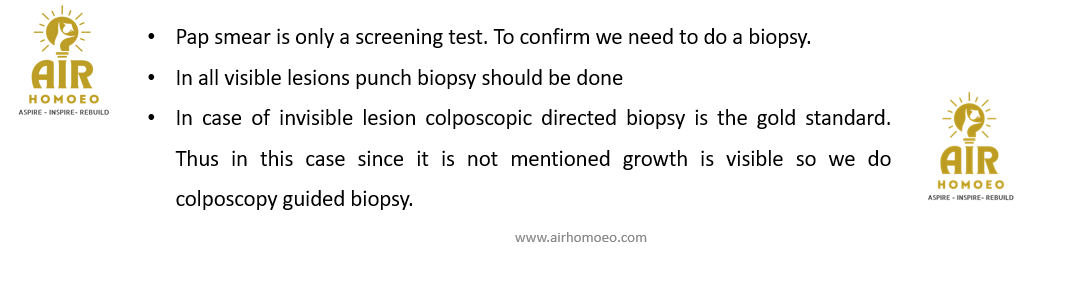
Pap smear of Mrs. L 45 years female shows CIN grade III. Which of the following is the next step in management:
Correct
 Incorrect
Unattempted
-
Question 20 of 50
20. Question
Which of the following statements about squamous cell carcinoma of cervix is false –
Correct
Squamous cell carcinoma of the cervix most commonly arises at the squamocolumnar junction (transformation zone), and HPV types 16 and 18 are indeed strongly associated with high-risk carcinogenesis. Postcoital bleeding is a common presenting symptom due to friable cervical tissue.
The false statement is that CT scan is mandatory for staging — FIGO staging of cervical cancer is clinical, based on pelvic examination, colposcopy, cystoscopy, proctoscopy, and chest X-ray. Imaging modalities like CT or MRI may be used for treatment planning, but they are not mandatory or included in official staging criteria.
Incorrect
Squamous cell carcinoma of the cervix most commonly arises at the squamocolumnar junction (transformation zone), and HPV types 16 and 18 are indeed strongly associated with high-risk carcinogenesis. Postcoital bleeding is a common presenting symptom due to friable cervical tissue.
The false statement is that CT scan is mandatory for staging — FIGO staging of cervical cancer is clinical, based on pelvic examination, colposcopy, cystoscopy, proctoscopy, and chest X-ray. Imaging modalities like CT or MRI may be used for treatment planning, but they are not mandatory or included in official staging criteria.
Unattempted
Squamous cell carcinoma of the cervix most commonly arises at the squamocolumnar junction (transformation zone), and HPV types 16 and 18 are indeed strongly associated with high-risk carcinogenesis. Postcoital bleeding is a common presenting symptom due to friable cervical tissue.
The false statement is that CT scan is mandatory for staging — FIGO staging of cervical cancer is clinical, based on pelvic examination, colposcopy, cystoscopy, proctoscopy, and chest X-ray. Imaging modalities like CT or MRI may be used for treatment planning, but they are not mandatory or included in official staging criteria.
-
Question 21 of 50
21. Question
A 35 years old lady presents with post coital bleeding and foul smelling discharge is most important investigation to arive at a diagnosis is
Correct
In a woman with postcoital bleeding and foul-smelling discharge, the most likely suspicion is carcinoma of the cervix. The gold standard for diagnosis is histopathological confirmation from the lesion itself.
Among the options, cervical biopsy (preferably colposcopy-directed) is the most important investigation to confirm the diagnosis.Procedures like endometrial aspiration, dilatation & curettage, or endometrial biopsy are indicated for uterine/endometrial pathologies and not primary for suspected cervical malignancy.
Incorrect
In a woman with postcoital bleeding and foul-smelling discharge, the most likely suspicion is carcinoma of the cervix. The gold standard for diagnosis is histopathological confirmation from the lesion itself.
Among the options, cervical biopsy (preferably colposcopy-directed) is the most important investigation to confirm the diagnosis.Procedures like endometrial aspiration, dilatation & curettage, or endometrial biopsy are indicated for uterine/endometrial pathologies and not primary for suspected cervical malignancy.
Unattempted
In a woman with postcoital bleeding and foul-smelling discharge, the most likely suspicion is carcinoma of the cervix. The gold standard for diagnosis is histopathological confirmation from the lesion itself.
Among the options, cervical biopsy (preferably colposcopy-directed) is the most important investigation to confirm the diagnosis.Procedures like endometrial aspiration, dilatation & curettage, or endometrial biopsy are indicated for uterine/endometrial pathologies and not primary for suspected cervical malignancy.
-
Question 22 of 50
22. Question
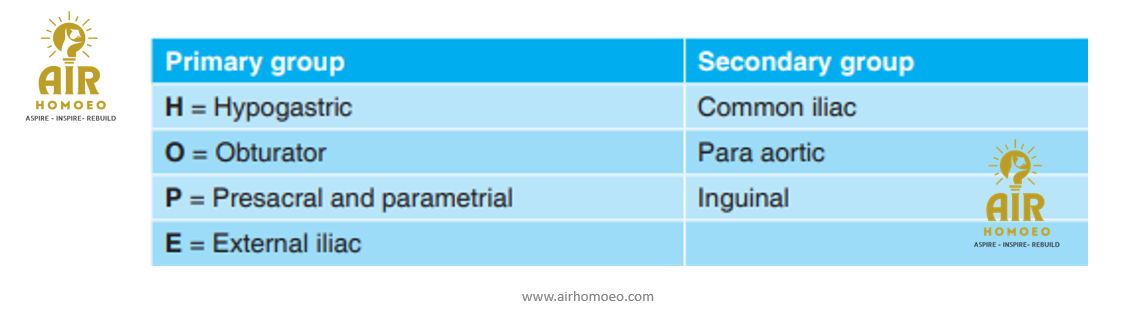
Primary LN involved in cervical cancer
A. Inguinal LN
B. Obturator LN
C. Hypogastric LN
D. External Iliac LN
E. Femoral LNCorrect
 Incorrect
Unattempted
-
Question 23 of 50
23. Question
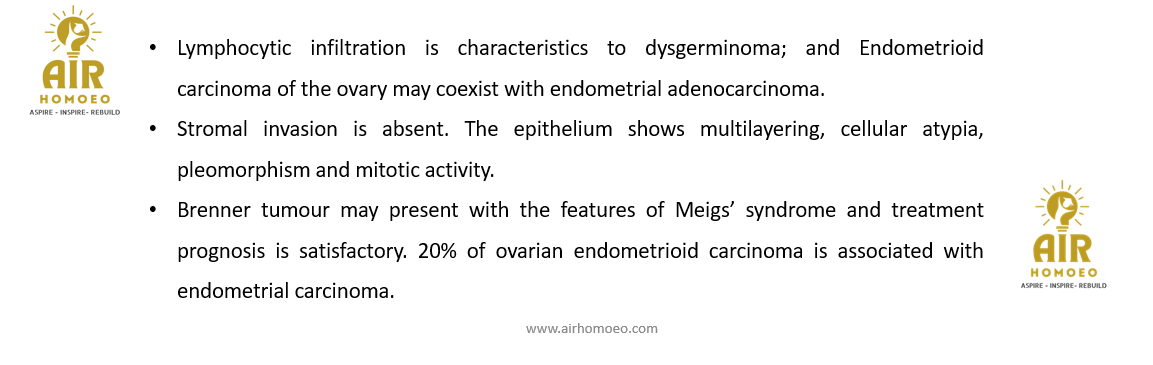
True regarding neoplasms of the ovary are:
A. Stromal invasion is commonly present in ovarian tumours of borderline malignancy
B. Lymphocytic infiltration is characteristic to dysgerminoma
C. Presence of ascites and pleural effusion in Brenner tumour indicates poor prognosis
D. Endometrioid carcinoma of the ovary may coexist with endometrial adenocarcinomaCorrect
 Incorrect
Unattempted
-
Question 24 of 50
24. Question
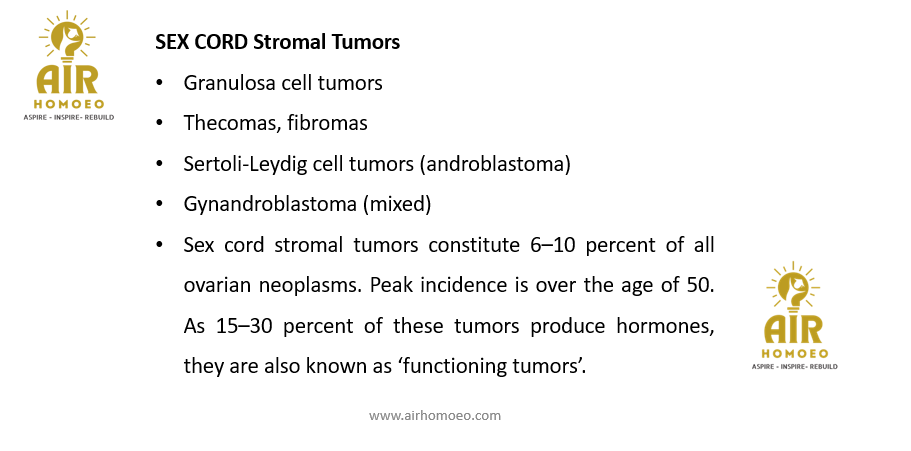
Sex cord stromal tumours of the ovary include all except:
Correct
 Incorrect
Unattempted
-
Question 25 of 50
25. Question
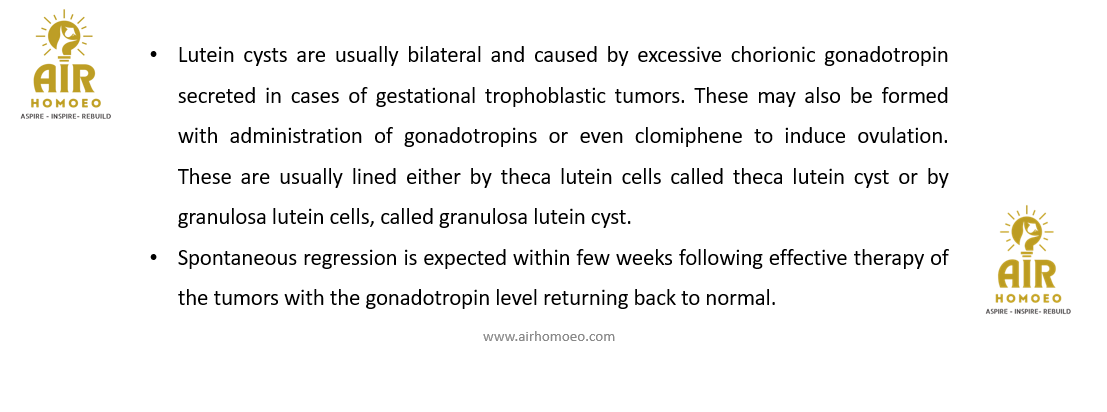
Lutein cysts are associated with all except:
Correct
 Incorrect
Unattempted
-
Question 26 of 50
26. Question
The most malignant endometrial carcinoma is
Correct
Among endometrial carcinomas, clear cell carcinoma is considered the most malignant. It belongs to Type II endometrial cancers, which are estrogen-independent, high-grade tumors often occurring in atrophic endometrium of postmenopausal women. These tumors have a higher propensity for early myometrial invasion, lymphovascular spread, and poor prognosis compared to endometrioid adenocarcinoma (Type I).
Other options:
Adenocarcinoma (endometrioid type): Most common but relatively less aggressive.
Adenoacanthoma: Variant with benign squamous differentiation, often better prognosis.
Mixed adenosquamous carcinoma: More aggressive than pure adenocarcinoma but still less malignant than clear cell carcinoma.
Incorrect
Among endometrial carcinomas, clear cell carcinoma is considered the most malignant. It belongs to Type II endometrial cancers, which are estrogen-independent, high-grade tumors often occurring in atrophic endometrium of postmenopausal women. These tumors have a higher propensity for early myometrial invasion, lymphovascular spread, and poor prognosis compared to endometrioid adenocarcinoma (Type I).
Other options:
Adenocarcinoma (endometrioid type): Most common but relatively less aggressive.
Adenoacanthoma: Variant with benign squamous differentiation, often better prognosis.
Mixed adenosquamous carcinoma: More aggressive than pure adenocarcinoma but still less malignant than clear cell carcinoma.
Unattempted
Among endometrial carcinomas, clear cell carcinoma is considered the most malignant. It belongs to Type II endometrial cancers, which are estrogen-independent, high-grade tumors often occurring in atrophic endometrium of postmenopausal women. These tumors have a higher propensity for early myometrial invasion, lymphovascular spread, and poor prognosis compared to endometrioid adenocarcinoma (Type I).
Other options:
Adenocarcinoma (endometrioid type): Most common but relatively less aggressive.
Adenoacanthoma: Variant with benign squamous differentiation, often better prognosis.
Mixed adenosquamous carcinoma: More aggressive than pure adenocarcinoma but still less malignant than clear cell carcinoma.
-
Question 27 of 50
27. Question
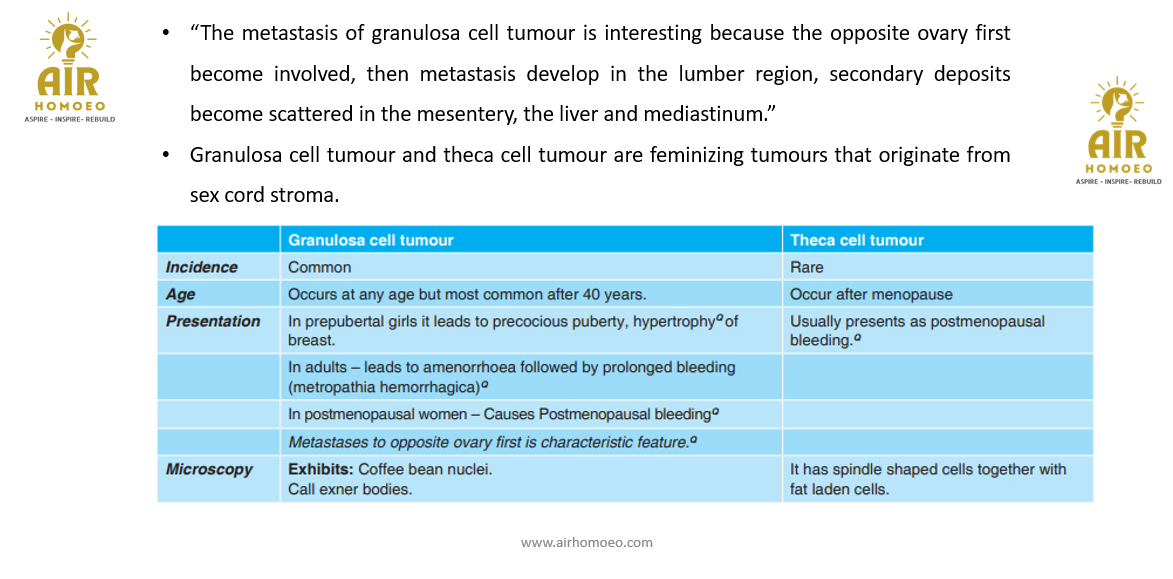
Which ovarian tumor is likely to involve the opposite
ovary by metastasis?Correct
 Incorrect
Unattempted
-
Question 28 of 50
28. Question
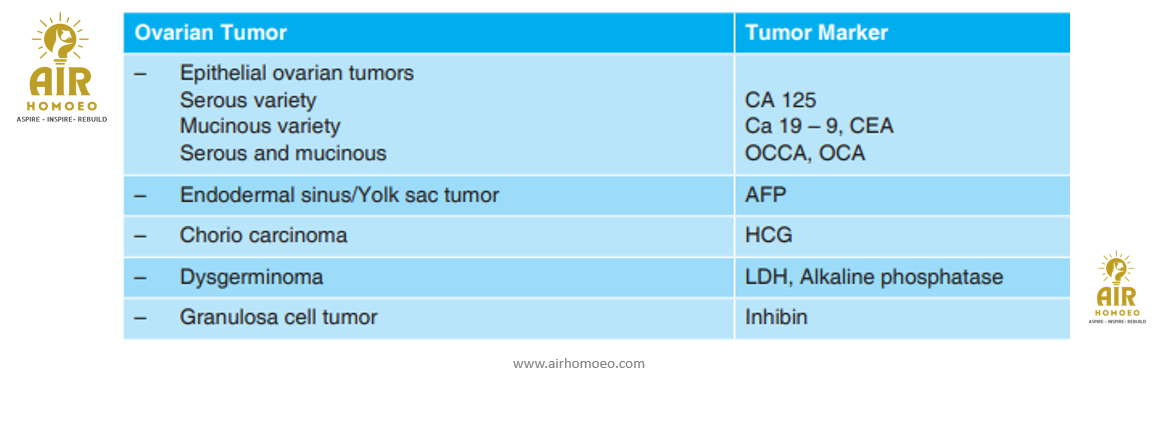
Marker for granulosa cell tumor:
Correct
 Incorrect
Unattempted
-
Question 29 of 50
29. Question
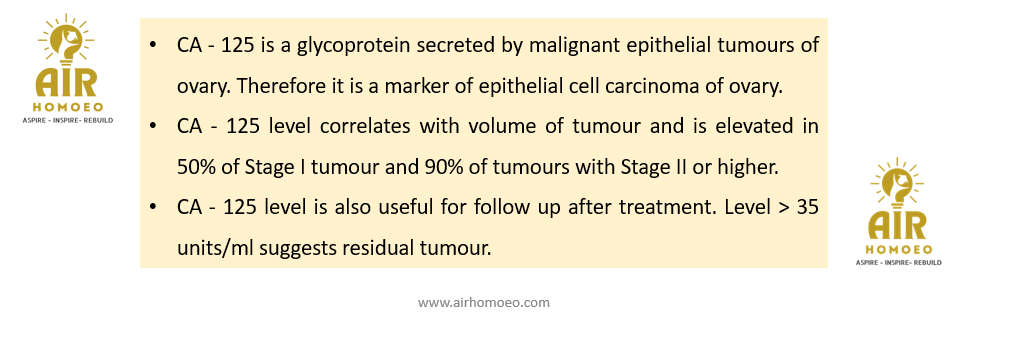
CA – 125 is specific marker of:
Correct
 Incorrect
Unattempted
-
Question 30 of 50
30. Question
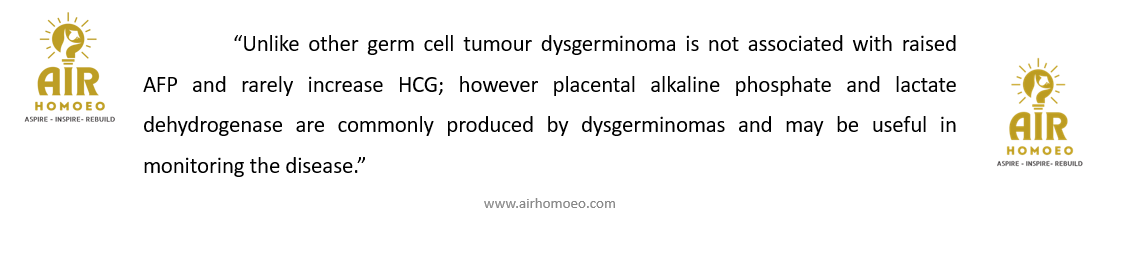
Which is raised in dysgerminoma?
Correct
 Incorrect
Unattempted
-
Question 31 of 50
31. Question
Which are seen in endodermal sinus tumor?
Correct
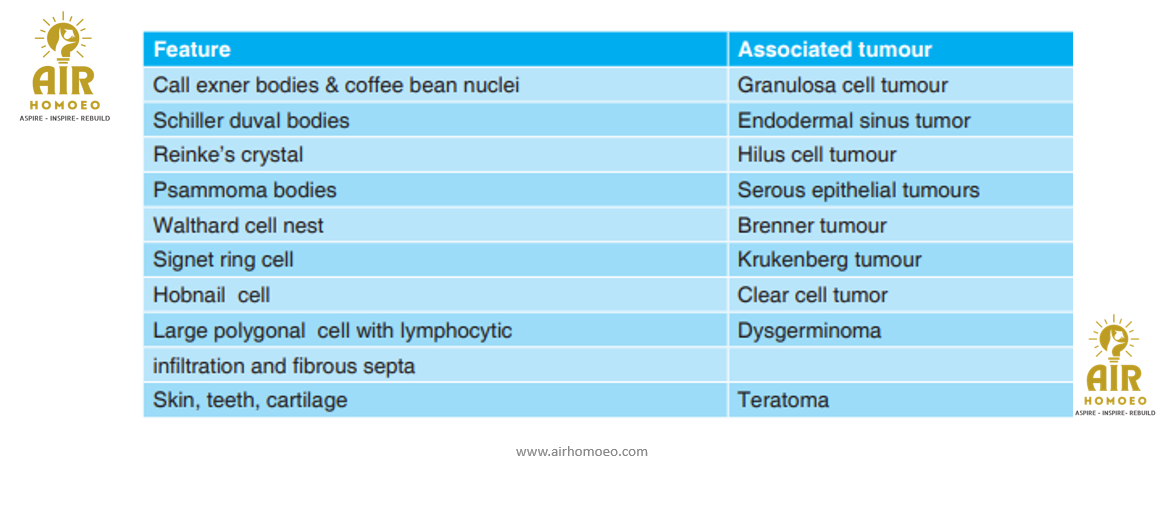 Incorrect
Unattempted
-
Question 32 of 50
32. Question
A lady has ovarian mass, X-ray pelvis shows a radiopaque shadow. The probable diagnosis is
Correct
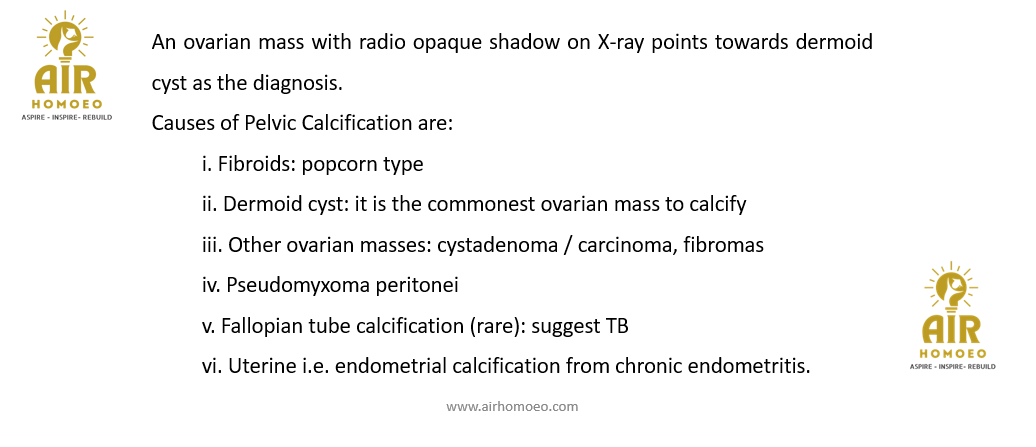 Incorrect
Unattempted
-
Question 33 of 50
33. Question
Attacks of flushing and cyanosis occur in which type of ovarian tumors:
Correct
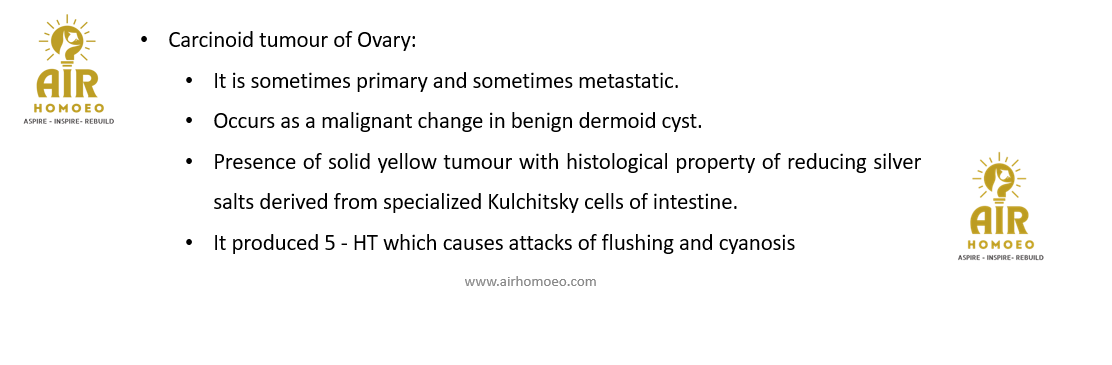 Incorrect
Unattempted
-
Question 34 of 50
34. Question
The pseudomyxoma peritonei occurs as a complication of the following ovarian tumours:
Correct
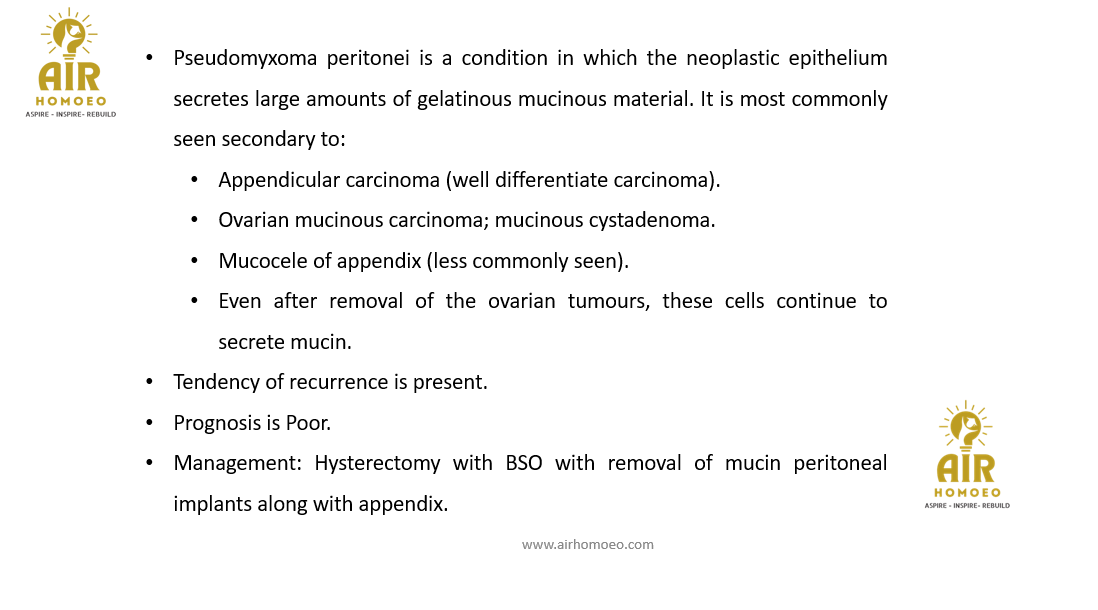 Incorrect
Unattempted
-
Question 35 of 50
35. Question
Most common ovarian cyst to undergo torsion:
Correct
 Incorrect
Unattempted
-
Question 36 of 50
36. Question
Which is not a germ cell tumour
Correct
Granulosa-theca cell tumor is not a germ cell tumor — it is a sex cord–stromal tumor arising from ovarian stroma, often estrogen-producing, and associated with endometrial hyperplasia or carcinoma.
Other options:
Dysgerminoma: Malignant germ cell tumor, ovarian counterpart of seminoma.
Teratoma: Germ cell tumor containing elements from all three germ layers (can be benign or malignant).
Embryonal carcinoma: Rare malignant germ cell tumor.
Incorrect
Granulosa-theca cell tumor is not a germ cell tumor — it is a sex cord–stromal tumor arising from ovarian stroma, often estrogen-producing, and associated with endometrial hyperplasia or carcinoma.
Other options:
Dysgerminoma: Malignant germ cell tumor, ovarian counterpart of seminoma.
Teratoma: Germ cell tumor containing elements from all three germ layers (can be benign or malignant).
Embryonal carcinoma: Rare malignant germ cell tumor.
Unattempted
Granulosa-theca cell tumor is not a germ cell tumor — it is a sex cord–stromal tumor arising from ovarian stroma, often estrogen-producing, and associated with endometrial hyperplasia or carcinoma.
Other options:
Dysgerminoma: Malignant germ cell tumor, ovarian counterpart of seminoma.
Teratoma: Germ cell tumor containing elements from all three germ layers (can be benign or malignant).
Embryonal carcinoma: Rare malignant germ cell tumor.
-
Question 37 of 50
37. Question
Pain of ovarian carcinoma is referred to:
Correct
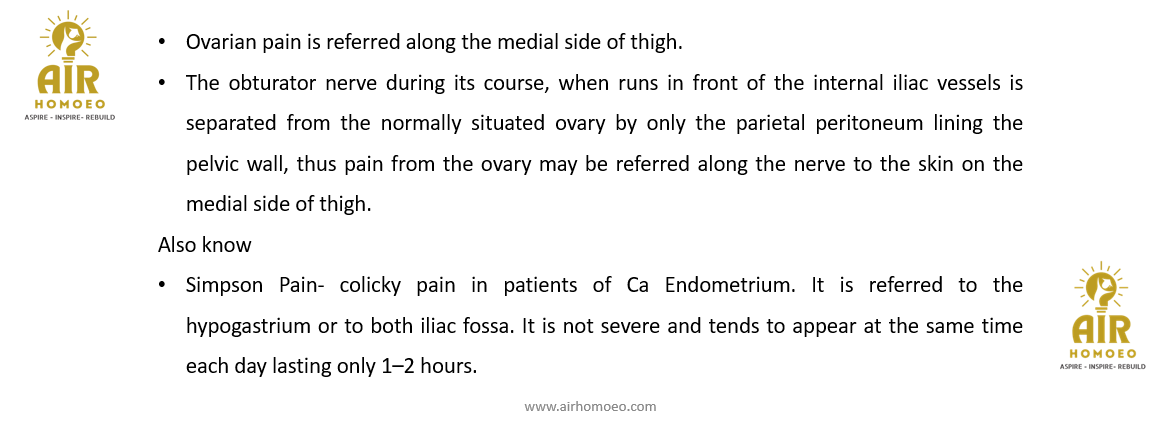 Incorrect
Unattempted
-
Question 38 of 50
38. Question
The following tumours commonly metastasize to the ovary, except:
Correct
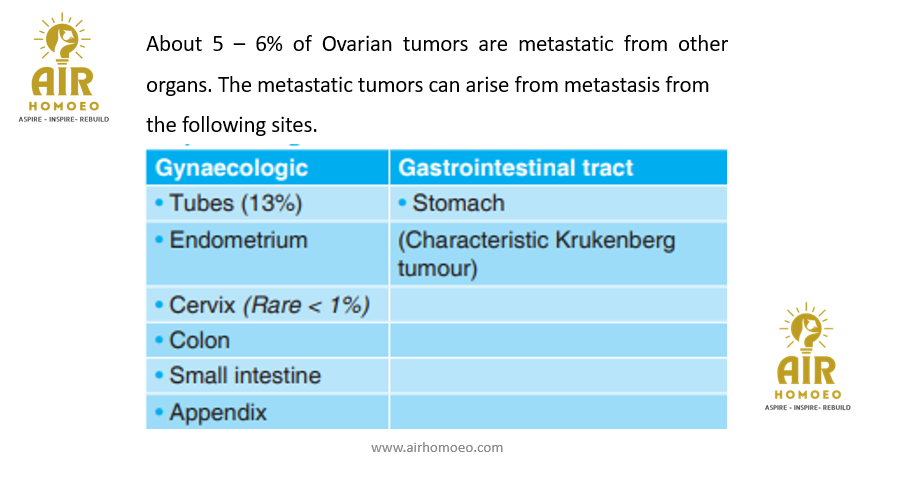 Incorrect
Unattempted
-
Question 39 of 50
39. Question
The following are long term complications of PCOS except –
Correct
Long-term complications of PCOS include type II diabetes mellitus, cardiovascular disease (due to metabolic syndrome, dyslipidemia, and insulin resistance), and endometrial cancer (from prolonged unopposed estrogen exposure leading to endometrial hyperplasia).
Ovarian cancer is not a recognized long-term complication of PCOS — current evidence does not show a significant increase in ovarian cancer risk in PCOS patients.Incorrect
Long-term complications of PCOS include type II diabetes mellitus, cardiovascular disease (due to metabolic syndrome, dyslipidemia, and insulin resistance), and endometrial cancer (from prolonged unopposed estrogen exposure leading to endometrial hyperplasia).
Ovarian cancer is not a recognized long-term complication of PCOS — current evidence does not show a significant increase in ovarian cancer risk in PCOS patients.Unattempted
Long-term complications of PCOS include type II diabetes mellitus, cardiovascular disease (due to metabolic syndrome, dyslipidemia, and insulin resistance), and endometrial cancer (from prolonged unopposed estrogen exposure leading to endometrial hyperplasia).
Ovarian cancer is not a recognized long-term complication of PCOS — current evidence does not show a significant increase in ovarian cancer risk in PCOS patients. -
Question 40 of 50
40. Question
Call-Exner bodies are seen in
Correct
Call–Exner bodies are small, eosinophilic, fluid-filled spaces between granulosa cells, resembling immature follicles. They are characteristic of granulosa cell tumors, a type of sex cord–stromal tumor of the ovary. These tumors often produce estrogen, leading to symptoms such as precocious puberty in children or abnormal uterine bleeding in adults.
They are not seen in yolk sac tumor (which shows Schiller–Duval bodies), choriocarcinoma (which shows cytotrophoblasts and syncytiotrophoblasts without villi), or dysgerminoma (which shows large clear cells with central nuclei, “fried-egg” appearance).Incorrect
Call–Exner bodies are small, eosinophilic, fluid-filled spaces between granulosa cells, resembling immature follicles. They are characteristic of granulosa cell tumors, a type of sex cord–stromal tumor of the ovary. These tumors often produce estrogen, leading to symptoms such as precocious puberty in children or abnormal uterine bleeding in adults.
They are not seen in yolk sac tumor (which shows Schiller–Duval bodies), choriocarcinoma (which shows cytotrophoblasts and syncytiotrophoblasts without villi), or dysgerminoma (which shows large clear cells with central nuclei, “fried-egg” appearance).Unattempted
Call–Exner bodies are small, eosinophilic, fluid-filled spaces between granulosa cells, resembling immature follicles. They are characteristic of granulosa cell tumors, a type of sex cord–stromal tumor of the ovary. These tumors often produce estrogen, leading to symptoms such as precocious puberty in children or abnormal uterine bleeding in adults.
They are not seen in yolk sac tumor (which shows Schiller–Duval bodies), choriocarcinoma (which shows cytotrophoblasts and syncytiotrophoblasts without villi), or dysgerminoma (which shows large clear cells with central nuclei, “fried-egg” appearance). -
Question 41 of 50
41. Question
Which of the following are masculinizing tumors of the ovary?
Correct
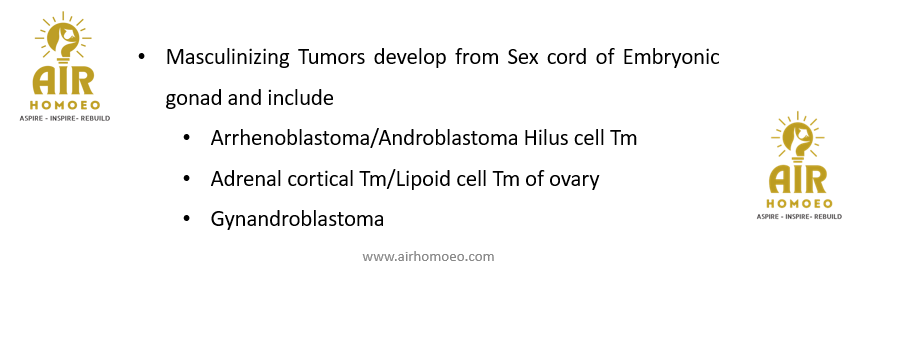 Incorrect
Unattempted
-
Question 42 of 50
42. Question
True about Brenner tumor:
Correct
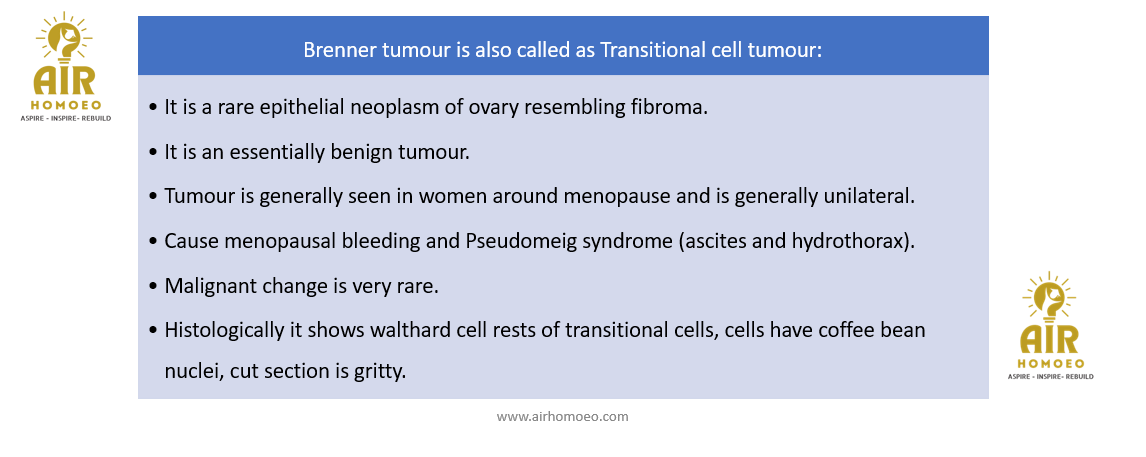 Incorrect
Unattempted
-
Question 43 of 50
43. Question
Marker of endodermal sinus tumor is
Correct
Endodermal sinus tumor (also called yolk sac tumor) is a malignant germ cell tumor of the ovary (or testis) that is highly aggressive and occurs most commonly in children and young women.
The characteristic tumor marker is α-fetoprotein (AFP), which is elevated in serum and can be used both for diagnosis and follow-up after treatment.a) α-fetoprotein → Correct; produced by tumor cells mimicking yolk sac elements.
b) hCG → Marker for choriocarcinoma and some germ cell tumors like embryonal carcinoma.
c) LDH → Marker for dysgerminoma.
d) CA-125 → Marker for epithelial ovarian cancers.
Incorrect
Endodermal sinus tumor (also called yolk sac tumor) is a malignant germ cell tumor of the ovary (or testis) that is highly aggressive and occurs most commonly in children and young women.
The characteristic tumor marker is α-fetoprotein (AFP), which is elevated in serum and can be used both for diagnosis and follow-up after treatment.a) α-fetoprotein → Correct; produced by tumor cells mimicking yolk sac elements.
b) hCG → Marker for choriocarcinoma and some germ cell tumors like embryonal carcinoma.
c) LDH → Marker for dysgerminoma.
d) CA-125 → Marker for epithelial ovarian cancers.
Unattempted
Endodermal sinus tumor (also called yolk sac tumor) is a malignant germ cell tumor of the ovary (or testis) that is highly aggressive and occurs most commonly in children and young women.
The characteristic tumor marker is α-fetoprotein (AFP), which is elevated in serum and can be used both for diagnosis and follow-up after treatment.a) α-fetoprotein → Correct; produced by tumor cells mimicking yolk sac elements.
b) hCG → Marker for choriocarcinoma and some germ cell tumors like embryonal carcinoma.
c) LDH → Marker for dysgerminoma.
d) CA-125 → Marker for epithelial ovarian cancers.
-
Question 44 of 50
44. Question
Which of the following most commonly causes intraorbital metastasis in female?
Correct
 Incorrect
Unattempted
-
Question 45 of 50
45. Question
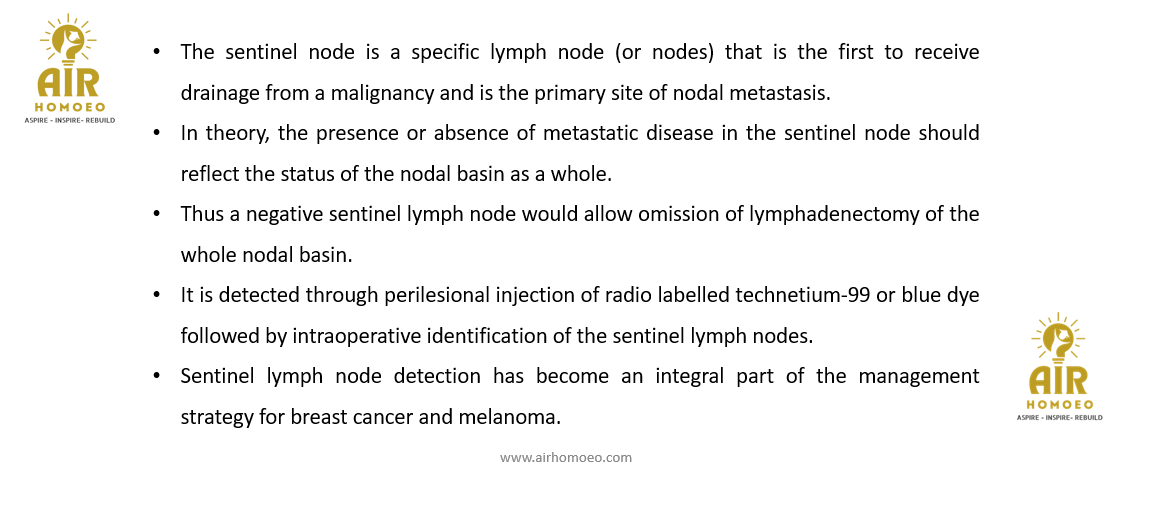
Sentinel biopsy most effective in:
Correct
 Incorrect
Unattempted
-
Question 46 of 50
46. Question
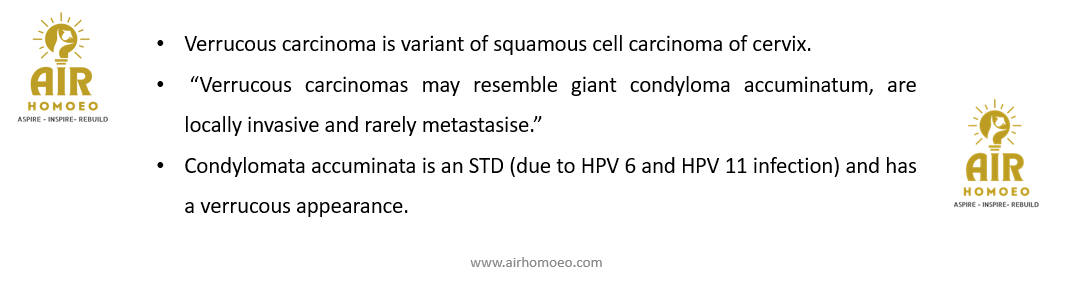
Common differential diagnosis of verrucous carcinoma is:
Correct
 Incorrect
Unattempted
-
Question 47 of 50
47. Question
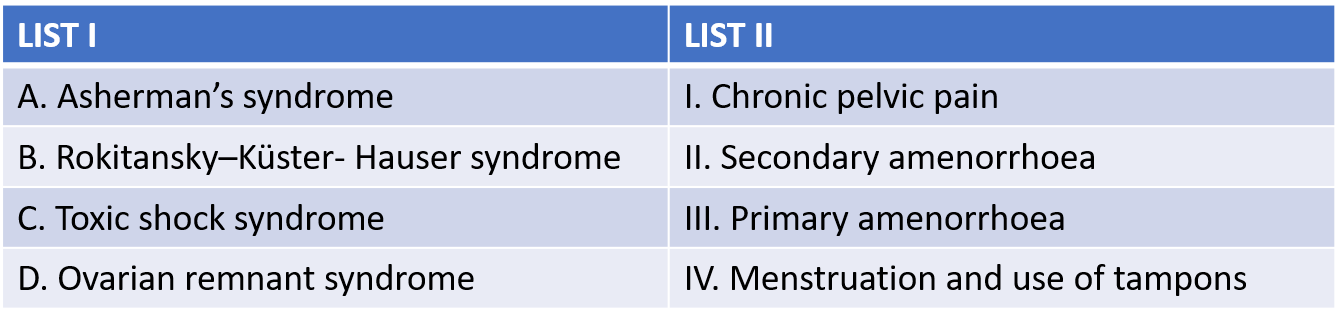
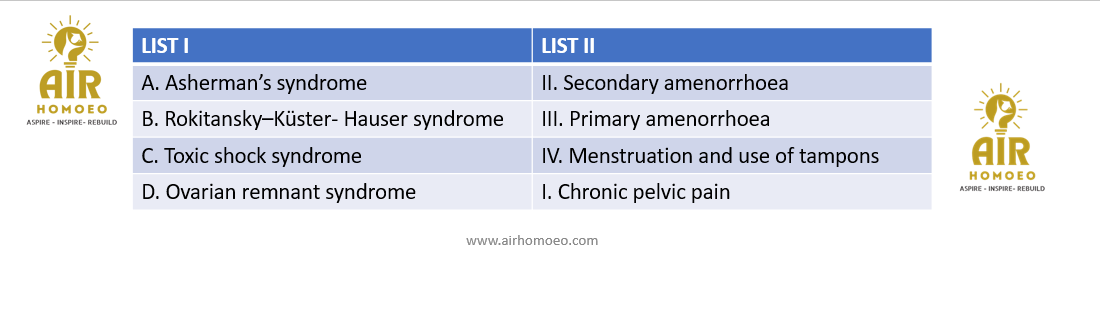
Match the following appropriately:
 Correct
 Incorrect
Unattempted
-
Question 48 of 50
48. Question
The biochemical changes in established cases of Stein Leventhal syndrome are as mentioned except:
Correct
 Incorrect
Unattempted
-
Question 49 of 50
49. Question
Given below are two statements.
Statement I: The ovary is covered by a single layer of cubical cell known as germinal epithelium of Waldeyer.
Statement II: Ovary is formed at T10 and then descends down in the pelvis with the help of Gubernaculum.
In the light of the above statements, choose the most appropriate answer from the options given below:Correct
 Incorrect
Unattempted
-
Question 50 of 50
50. Question
Most common cause of postmenopausal bleeding in women in India is
Correct
In India, the most common cause of postmenopausal bleeding is cancer cervix, whereas in many Western countries, endometrial carcinoma is more common.
This difference is due to the higher prevalence of cervical cancer in India, related to lower screening rates and higher HPV infection burden.Incorrect
In India, the most common cause of postmenopausal bleeding is cancer cervix, whereas in many Western countries, endometrial carcinoma is more common.
This difference is due to the higher prevalence of cervical cancer in India, related to lower screening rates and higher HPV infection burden.Unattempted
In India, the most common cause of postmenopausal bleeding is cancer cervix, whereas in many Western countries, endometrial carcinoma is more common.
This difference is due to the higher prevalence of cervical cancer in India, related to lower screening rates and higher HPV infection burden.